
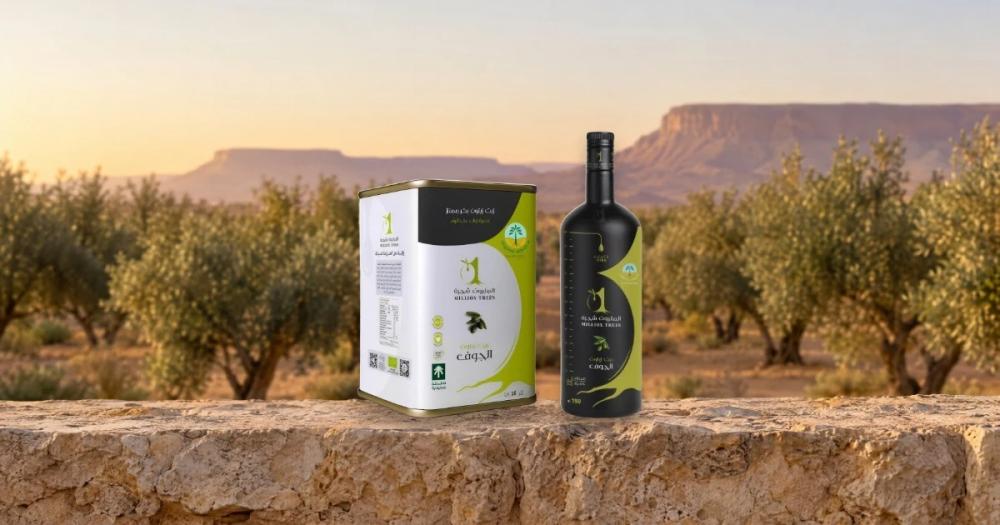
The description "Al-Jawf olive oil" is frequently found in stores and online platforms, but buyers rarely find an explanation of what distinguishes this oil from others, or why two bottles from the same region can differ in color, taste, and price. As a result, many people choose based on price or packaging, then judge the entire oil based on a single experience.
We wrote this guide based on information from the website of those who grow olives in Al-Jawf. After reading it, you will understand how the region's climate shapes the oil's character, the difference between early and late harvests, how to correctly read the label, choose a size suitable for your household, store the oil in the Saudi summer heat, and taste it yourself to judge its quality.
In short: Al-Jawf olive oil comes from a relatively high-altitude desert environment with cold winters and hot, dry summers. The trees are irrigated by drip irrigation, which influences the oil's flavor and stability. Early harvests produce a sharp, green oil with a herbaceous note, while late harvests yield a smoother, golden oil. Look for the label "extra virgin olive oil" with a recent harvest and a bottle that will be used within two to three months of opening. Store it away from light and heat, and taste it slightly warm before making a final judgment.
Why is Al-Jawf olive oil different? Climate, altitude, and irrigation.

Al-Jawf, located in the north of the Kingdom on a plateau relatively high above sea level, is home to millions of olive trees, making it one of the largest olive-producing regions in the Kingdom. This environment differs from the Mediterranean basin where olives originated, but it shares the basic conditions required by the tree and adds unique factors that influence the oil.
A cold winter is sufficient for the tree to flower.
The olive tree does not flower well without a period of cold winter weather. It needs several weeks where the temperature drops to approximately 10 degrees Celsius for the flower buds that will develop into fruit the following season to form. The winters in Al-Jawf region clearly provide this cold, and nighttime temperatures can approach freezing on some days. This is why olives thrive more in the north than in warmer regions of the Kingdom where the trees do not receive sufficient cold, resulting in a lower yield.
hot, dry summer
Low humidity in summer reduces fungal diseases affecting leaves and fruit in humid orchards, and high temperatures weaken the activity of the olive fruit fly, one of the most damaging pests to oil quality because punctured fruit oxidizes and ferments quickly before reaching the press. A healthy fruit at pressing is essential for producing low-acidity, clean-tasting oil.
Irrigated agriculture in the heart of the desert
Unlike many Mediterranean olive groves, the olive groves of Al-Jawf do not rely on rainfall, but rather on drip irrigation from groundwater. This gives farmers control over the quantity and timing of watering. It is well-established in olive cultivation that carefully reducing irrigation at specific stages of fruit development increases the concentration of phenolic compounds, which are responsible for the bitterness and heat in the throat, while excessive irrigation produces a larger quantity of oil with a milder flavor. Therefore, the character of the oil can differ between two adjacent groves depending on the irrigation method.
A clear difference between the temperature of night and day
Nights in high-altitude desert regions are much colder than days, especially in autumn when the fruit is nearing ripeness. This contrast slows the ripening process and gives the fruit more time to develop its aroma compounds, resulting in oil with a distinct fruity flavor if it is picked at the right time and pressed quickly after harvesting, ideally within hours rather than days.
Harvest time: early, mid-season, and late harvest

The harvest season in Al-Jawf extends roughly from autumn to the beginning of winter, and within this period, the farmer decides when to harvest each part of the orchard. The timing of the harvest is the most significant factor affecting the oil after the variety, because a green fruit has a different composition than a ripe, blackened fruit.
At the beginning of the season, the fruit is green and firm, with a lower oil content, but it is rich in chlorophyll, phenolic compounds, and herbaceous aromatic compounds. As the season progresses, the fruit turns purple and then black, its oil content increases, and its bitterness and pungency gradually decrease. This is why oil from the early harvest is usually more expensive, as the farmer obtains a significantly smaller quantity of oil from the same ton of fruit.
The following table summarizes the main differences between the three stages as observed by the farmer and the taster.
| Stage | Color, taste, and smell | Oil quantity and stability | Most appropriate use |
| early harvest | Clear green oil, smell of cut grass and tomato leaves, bitterness and intense heat in the throat | Less oil content from the fruit, and longer shelf life thanks to phenolic compounds. | Salads, hummus, fava beans, bread dip, and thyme |
| Medium pick | Greenish-golden, a balance of fruit and bitterness, a flavor of almond or green apple | Moderate oil quantity and good stability | Daily use between salads and light cooking |
| late harvest | Light golden, smooth taste reminiscent of ripe fruit, mild bitterness and heat | Higher oil content, flavor deteriorates faster after opening | For those who prefer a milder flavor, cooked dishes, and pastries |
If you use the oil raw on dishes, early or medium-harvest oil gives you a clearer flavor. If most of your use is in cooking, the difference in taste decreases after heating. The most important thing then is that the oil is virgin, excellent quality, and freshly pressed.
Bitterness and heat in the throat are not a defect, but rather positive qualities in the tasting method adopted by the International Olive Council, and they gradually lessen in the first months after pressing.
Olive varieties grown in the Kingdom and their effect on taste
Several varieties are cultivated on farms in the Kingdom, some of which are of Mediterranean origin and were introduced for their suitability to irrigated and intensive farming. Mentioning these varieties does not mean that they are all present on every farm, as each producer has their own preferences. Some of the varieties cultivated in the Kingdom include:
- Arbequina: A small-fruited variety of Spanish origin, it gives a smooth, fruity oil with a hint of almond and apple, with a mild bitterness, and is suitable for those trying extra virgin olive oil for the first time.
- Koroneiki: A small-fruited Greek variety that tolerates heat and drought. Its oil is clearly herbaceous with a noticeable sharpness and high stability in storage.
- Picual: A Spanish variety that is widespread worldwide. Its oil is rich in oleic acid and very stable, and its flavor is reminiscent of fig leaves and tomato leaves with a clear bitterness in the early harvest.
- Frantoio: An Italian variety from Tuscany, its oil is fruity and balanced, and its heat appears in the throat seconds after tasting, not at the first moment.
Some producers blend oils from different varieties on the same farm to achieve a consistent, balanced flavor each season. This is a well-known practice that doesn't diminish quality as long as the blend is all extra virgin. The variety alone doesn't determine quality; a single variety can yield excellent or average oil depending on the harvest date, pressing speed, and the cleanliness of the press. Ultimately, laboratory analysis and taste testing are the deciding factors.
How to read an olive oil bottle label

Check these items on the label in order before you buy:
- Grade: Look specifically for the phrase "extra virgin olive oil." The terms "olive oil" alone or "pure olive oil" often refer to a mixture of refined oil and a small amount of virgin olive oil, while "pomace oil" is oil extracted from the residue of oil pressing using solvents and then refined. We explained these grades in detail in our article on the difference between extra virgin, virgin, and refined olive oil .
- The harvest season is the most reliable indicator of the oil's freshness. A product that clearly states the season, such as "2025/2026 season," provides information that an expiration date cannot.
- The expiration date is usually calculated 18 to 24 months after the bottling date, not the harvest date. Oil that is a year old may have a much later expiration date. Compare the two dates, if available.
- Origin and place of cultivation: The phrase "packaged in" differs from "grown and pressed in." Locally packaged oil may be entirely imported, while genuine Al-Jawf oil states the region and the name of the producing entity.
- Acidity: If mentioned, it should not exceed 0.8% in extra virgin olive oil according to the standards of the International Olive Council. Low acidity is a necessary condition, but it alone does not tell you about the taste or the age of the oil. Details are in the article "Olive Oil Acidity and What Its Numbers Mean ."
- Extraction method: The term "cold-pressed" has a specific meaning in European legislation, which is that the oil paste temperature should not exceed 27 degrees Celsius during extraction. The term "first pressing" is a reference to the time of stone presses, as modern presses extract the oil in a single press using centrifugal force.
- Batch number and product details: A clear batch number, company name, address and contact information are all signs of a product that takes responsibility for its oil and can provide you with analysis results.
How to choose the right package size for your home
The correct amount is the amount you finish before the oil loses its flavor. Once opened, air enters and oxidation begins slowly. It is generally recommended to consume the oil within two to three months of opening to enjoy its full flavor.
To estimate your consumption, observe a typical week in your kitchen: two tablespoons on a plate of fava beans for breakfast, a sprinkle on salad and hummus, and a small amount to sauté onions before kabsa or stew. A household that cooks daily with olive oil consumes far more than they expect.
The following table shows the sizes of the "Million Trees" font and who each one is suitable for. Prices include VAT at the time of writing and may change with offers.
| Size and packaging | the price | Suitable | Practical observation |
| 500 ml glass | 45 | One or two people, or a serving bottle on the table | Finish it before its flavor fades |
| 750 ml glass | 66 | A small family uses raw oil on their dishes. | Store it in a dark cupboard because the glass allows some light to pass through. |
| 1 liter can | 72 | For those who want complete protection from light in a moderate size | The metal casing completely blocks out the light. |
| 2 liter can | 135 | An average family cooks with olive oil several times a week | Pour some of it into a small bottle for daily use. |
| 4 liter can | 235 | A large family or a kitchen that cooks daily | The price per liter is significantly lower than in smaller packages. |
| 8 liter or 16 liter can | 450 596 | Seasonal stock for extended family or for division among multiple households | After opening, divide it into smaller, airtight containers. |
The larger the volume, the lower the price per liter, but the savings are only real if you consume the oil or divide it into smaller containers before its quality deteriorates. For a more comprehensive comparison between the two options, see the article "Should You Buy Olive Oil by the Liter or by the Can ?"
Olive oil storage in the Saudi climate
Olive oil has four enemies: light, heat, air, and time. Heat, in particular, poses the greatest challenge in our homes. Summer kitchen temperatures often exceed what the oil needs, and inside a closed car, temperatures can rise to levels that damage its flavor within a few hours. A well-stored, sealed container preserves its quality for a long time, but it's best consumed within one to one and a half years of the harvest.
- Store the container in a dark cupboard away from the oven, stove, and dishwasher. The ideal temperature is between approximately 15 and 20 degrees Celsius, and below 25 degrees is acceptable in most air-conditioned homes.
- Do not leave the oil in the car after purchase, and do not store spare containers in the warehouse or an unconditioned annex.
- Close the lid tightly after each use, as air accelerates oxidation.
- If you buy a large container, fill a small dark bottle with some of it for everyday use, and keep the large container closed in a cool place.
- There is no need to put the oil in the refrigerator. It may become cloudy or partially freeze and then return to normal at room temperature, but repeated refrigeration and heating and condensation of moisture upon opening do not help it.
- Do not refill the same bottle without washing and drying it, as remnants of old oil accelerate the rancidity of the new oil.
You can find more practical details in the guide on how to store olive oil .
How to taste olive oil at home
A small cup and a few minutes are enough. It is best to taste it before or an hour after eating, not immediately after coffee.
- Put about a tablespoon, or about 15 ml, into a small cup, and cover it with your palm.
- Hold the cup in the palm of your hand for a minute or two until the oil warms up slightly, as the warmth releases the aroma compounds.
- Stir the oil in a circular motion, then lift your hand and inhale directly. Good oil has a fresh fruit aroma: grass, green leaves, apples, almonds, or tomatoes.
- Take a small sip and leave it on your tongue, then draw the air from between your teeth along with the oil with an audible sound, so that it spreads in the mouth and its vapor reaches the nose.
- Notice the bitterness on the back of your tongue, then swallow and wait a few seconds: the stinging sensation in your throat may prompt you to cough, a positive attribute stemming from natural phenolic compounds in the fresh oil.
The defects to watch out for include: an odor resembling crayon or old nuts, which is a sign of rancidity; an odor of fermented olives or mud, indicating that the olives were left to stand for too long before pressing; a musty or vinegary smell; and a metallic taste. The presence of any of these means the oil does not deserve the title of extra virgin, no matter how low its acidity is.
Comparison tip: Taste two oils in two adjacent glasses. Differences you wouldn't notice in one oil become clear when compared, and this is the quickest way to train your nose and tongue.
Do not judge oil by its color, as the color is affected by the variety and the harvest date, which is why professionals taste it in dark blue cups that conceal it.
Al-Jawf olive oil from the Million Tree Farms

Our Million Trees Olive Oil comes from our farms in Al-Jawf, a region that boasts over 23 million olive trees, according to the Saudi Press Agency (2024). We cultivate our trees using modern, intensive planting methods in straight rows running from north to south. We harvest the olives mechanically and transport them directly to our on-site press, where the oil is cold-pressed using centrifugal force. Our store offers oil in three lines: the standard "Million Trees" line in metal cans and glass bottles, the special harvest line in dark glass and cans, and the "Nasser Olive" line, a more affordable option for everyday use.
The Certifications and Awards page showcases our organic farming certification from the Ministry of Environment, Water and Agriculture, our Saudi Food and Drug Authority license, ISO 22000 and HACCP certifications, and our international awards, including the gold medal at the 2024 Dubai International Olive Oil Competition in the Ultra Premium category. You can find our Al-Jawf olive oil in metal cans ranging from 1 to 16 liters, and our dark glass bottles in 100 to 750 ml in the Glass section . We also offer our special harvest line in cans and dark glass.
Frequently Asked Questions
Is all olive oil from Al-Jawf extra virgin?
No. The region does not determine the grade; rather, it is determined by the results of analysis and tasting of each batch. Olives from Al-Jawf may be pressed to produce extra virgin or regular virgin oil depending on the condition of the fruit, the speed of pressing, and the cleanliness of the press. Therefore, read the grade on the label and request the results of the analysis.
When will the new season's oil reach the markets?
Harvesting in Al-Jawf begins roughly in autumn and continues until the beginning of winter. The new oil appears in the markets after pressing, filtering, and bottling. Early oil is sharper and greener at the start of the season, then its flavor softens as the months pass.
Why does olive oil sting the throat?
The pungency originates from natural phenolic compounds concentrated in fresh oil, especially early-harvested oil. It is a quality characteristic according to established taste standards, not a defect, and gradually diminishes as the oil ages.
Does the taste of the oil change from season to season?
Yes. Winter and summer temperatures vary from year to year, and olive trees tend to alternate between years of heavy and light fruit production, with harvest times changing according to fruit ripeness. Therefore, you might notice a slight difference in taste between two seasons from the same orchard, which is normal for an agricultural product.
Is extra virgin olive oil suitable for cooking and frying?
Yes. Extra virgin olive oil can withstand normal home cooking temperatures as long as you don't let it smoke, and its oleic acid and phenolic compound content helps it remain stable. While it might not be the most economical choice for frequent deep frying, it's very suitable for sautéing and everyday cooking.
What is the difference between Al-Jawf oil and imported oil?
The key difference lies in the shorter distance between the farm and the consumer. Locally produced oil doesn't undergo weeks of shipping and storage in ports and warehouses, stages during which the oil may be exposed to heat. Ultimately, the final judgment rests with the grade, analysis, and taste in both cases.
Choosing Al-Jawf olive oil doesn't require extensive experience: the "extra virgin" designation is clearly stated, it's from a recent harvest season, the size is suitable for your household consumption, and it's stored in a cool, dark place in the kitchen. Try tasting your oil as described above just once, and you'll find that your judgment of any bottle afterward becomes much more accurate.