
You might buy excellent olive oil from a recent harvest, only to see it lose much of its quality within weeks due to its packaging. A clear glass bottle on a kitchen shelf near a window, or a plastic flask in the trunk of your car on a summer's day, can easily turn a fragrant green oil into a dull, waxy-tasting one. And the question we often get is: which is better for storing oil, glass or tin?
The answer depends on understanding what happens inside oil when it is exposed to light, air, and heat. After reading this guide, you will know how each of these factors works, what protection each type of container offers, when to choose brown glass, lined tin, or stainless steel, and how to transport oil in the Kingdom's summer without spoiling it.
In short: Light is the fastest way to spoil olive oil, because its natural chlorophyll absorbs light and releases an active form of oxygen that attacks the fats. Food-grade lined containers completely block out light and are best for large quantities and long-term storage. Brown glass is better than green, and clear glass offers almost no protection unless stored in a dark box or cupboard. Plastic is only suitable for oils that are consumed quickly.
Three factors spoil oil: light, oxygen, and heat.

Olive oil is rich in monounsaturated fatty acids, most notably oleic acid, and contains a smaller percentage of polyunsaturated fatty acids such as linoleic acid. These acids have double bonds, which are the weak point that makes them susceptible to oxidation. When they oxidize, primary compounds called peroxides are formed, which then decompose into secondary compounds responsible for the rancid smell. Therefore, the International Olive Council (IOC) specifications measure the peroxide number and UV absorption coefficients (K232 and K270) as part of quality tests, as these are indicators of the extent of oxidation.
Light and chlorophyll: Photo-oxidation
Extra virgin olive oil, especially early virgin olive oil, contains chlorophyll pigments and their derivatives that give it its green color. These pigments act as photosensitizers in the presence of light: they absorb light energy, especially in the blue and red ranges, and then transfer it to oxygen molecules dissolved in the oil, converting them into what is called "single oxygen," a very reactive form of oxygen that reacts with the double bonds in fats much faster than ordinary oxygen, by a difference estimated in the scientific literature to be hundreds to thousands of times faster.
The practical result is that green oil, rich in chlorophyll and often considered the most valuable, is the most sensitive to light. A clear bottle under shop lighting or on a shelf near a window might show a noticeable decline in flavor within weeks, while the same oil in an opaque container remains in good condition for many months.
Oxygen: Auto-oxidation
Even in complete darkness, oil slowly oxidizes through a chain reaction called auto-oxidation, which begins with oxygen present in the space above the oil or seeping through the container wall or lid. Therefore, two things are important: the container must be oxygen-impermeable, and the air space inside it must be minimal. Some metals, such as iron and copper, accelerate this reaction, which is why oil should not be stored in unlined metal containers or in copper.
Heat: Accelerator of all reactions
Heat doesn't just spoil oil; it accelerates all the aforementioned processes. A well-known rule in chemistry is that the rate of many reactions nearly doubles with every ten-degree Celsius increase. Therefore, oil stored at 35 degrees Celsius in a summer kitchen deteriorates much faster than oil stored at 18 degrees Celsius in an air-conditioned cupboard, even if the containers are identical.
Glass: Clear, brown, and green
Glass itself is an excellent material for storing oil: it does not react with it, does not transfer odors, and does not allow oxygen to pass through its surface. Its only weakness is light, and this is where the color of the glass varies considerably.
clear glass
It allows almost all visible light and some ultraviolet rays to pass through. Its appearance is attractive and showcases the oil's color, but it offers little to no protection. If you buy oil in a clear bottle, store it in its cardboard box or in a closed cabinet; do not leave it on a shelf.
Brown (amber) glass
It blocks ultraviolet rays and most blue light, the most harmful range which chlorophyll strongly absorbs. Comparative studies on oil containers generally indicate that brown glass offers better protection than green, and therefore it is also used for storing medicines and light-sensitive materials.
dark green glass
It's the most common color for olive oil bottles, for both traditional and aesthetic reasons. It offers much better protection than clear, but allows more light to pass through than brown. The darker the color, the better the protection. In any case, a colored bottle in a dark cabinet offers almost the same level of protection from light as a tin one.
Lined food container
Metal olive oil cans are typically made from tin-plated steel, lined internally with a food-grade varnish. This lining is what makes tin suitable: it prevents direct contact between the oil and the metal, thus preventing any oxidation-causing effects from the iron. Tin completely blocks light and oxygen from penetrating its walls, and it is relatively lightweight and shatterproof, making it a practical choice for sizes ranging from 1 to 16 liters.
However, there are some points to note about the tank:
- Shocks and dents may tear the inner lining, so avoid buying cans that are badly dented or have rust around the edges and welds.
- You cannot see the oil level inside the tank, so you might think it is still full while there is a large air gap above it.
- The air space in large tanks expands with use, and for this reason we recommend emptying the large tank into smaller containers when opening it, as we explained in detail in the guide to choosing between a liter can and a 16-liter tank .
- Do not reuse unidentified metal cans that previously contained margarine or other substances, as their lining may be unsuitable or damaged.
Other options: stainless steel, plastic, and box bags
Stainless steel containers (Fosti)
In Mediterranean oil-producing regions, oil is stored in stainless steel containers called "fosti," preferably food-grade, such as AISI 304 (also known as 18/8). Their main advantage is a tap at the bottom, allowing you to access the oil without opening the top lid. Some models also feature a floating lid that rests directly on the oil's surface and sinks with it, minimizing contact with air. These are a good investment for those storing large quantities annually, provided they are thoroughly cleaned and dried before each filling, and the tap is cleaned regularly as oil residue can become rancid.
PET plastic
Polyethylene terephthalate (PET) containers are lightweight, inexpensive, and unbreakable, but oxygen slowly seeps through their walls, unlike glass and metal. Most PET containers are transparent, allowing light to pass through. Therefore, they are acceptable for oil consumed within a few weeks, but unsuitable for long-term storage or for extra virgin olive oil where you want to preserve its flavor. Avoid reusing plastic water bottles to transfer oil.
Bag-in-Box
A multi-layered bag inside a cardboard box, with a tap. Its advantage is that the bag shrinks as the oil is removed, preventing air from entering and replacing it, and the box blocks light. This option is popular with restaurants and some producers of three-liter and larger containers, and it's one of the best solutions for the vacuum problem. However, it's less durable than tin cans for long-term transport and storage, and less common in the local market.
The following table lists the types of packaging side by side according to the factors we have explained.
| Package type | Light protection | Protection from oxygen | Durability and optimal use |
| clear glass | Very weak, almost all the light passes through | Excellent across the wall, the cover is the limit | Fragile, only suitable for use inside a box or cabinet |
| dark green glass | Good, and it increases as the color gets darker. | Excellent across the wall | Fragile, suitable for table setting and gifts |
| amber brown glass | Very good, blocks UV rays and most blue light. | Excellent across the wall | Fragile, the best among glass for everyday use |
| Lined food container | Complete, no light gets through | Excellent, and the air gap after opening is the challenge. | Durable and lightweight, ideal for large sizes and transport. |
| Stainless steel (Fosti) | Complete, no light gets through | Excellent, especially with the floating cover. | Lasts for years, for large household stocks |
| PET plastic | It is often weak because most of it is transparent. | Moderate, oxygen leaks slowly through the wall | It doesn't break down, and the oil is consumed within just a few weeks. |
| bag inside box | Very good thanks to the cardboard | Excellent, the bag shrinks and no air gets in. | Less resistant to shocks, due to continuous high consumption. |
The conclusion from the table is that completely opaque containers (tin, stainless steel, and bag inside the box) are the strongest in protection, and that glass excels in non-reactivity and appearance, but it needs a dark place to give its best.
Caps and pouring nozzles
A good package can be ruined by a bad lid. Oxygen enters through the weakest point, which is often the spout. Practical observations from our kitchens:
- A screw-on lid with an inner lining is best for containers that are opened once or twice a day. Close it immediately after pouring, not at the end of cooking.
- The open metal pouring spouts commonly found in restaurants are convenient, but they always leave an air gap. If you use them, choose a type with a small, self-closing cap, or replace them with the original cap if the bottle will be kept for more than two weeks.
- Clean the nozzle periodically with hot water and dry it thoroughly, because the thin layer of oil on it oxidizes quickly, and drops of it may leak into the bottle.
- Cork stoppers are nice as gifts, but they absorb oil over time and may not seal as tightly as a screw-on cap.
- Oil sprayers are handy for salads and grilling, but fill them with small quantities and they'll run out in days.
Transportation heat in Saudi Arabia summer

Much of the damage to oil doesn't occur in the kitchen, but on the way from the store to the home. Summer temperatures exceed 45 degrees Celsius in many cities across the Kingdom, and the temperature inside a car parked in the sun can rise above 60 degrees, with the trunk not much cooler. A few hours in these conditions significantly accelerates oxidation, especially in clear glass and plastic.
- Make buying oil the last stop on your trip, and don't leave it in the car while you're running other errands.
- Place the package in the air-conditioned cabin instead of the trunk of the car, and away from direct sunlight through the glass.
- When ordering online, keep track of the delivery date and pick up the shipment yourself; don't leave it in front of the door at noon.
- For road trips and camping, choose a small metal can inside a cooler instead of glass.
- Upon arrival, place the oil directly into a dark cupboard, and don't worry if it becomes slightly cloudy after cooling quickly, as this will disappear on its own.
What do you choose: for everyday use, as a gift, or for stocking up?

There is no single perfect product for every situation, so many households combine two types. The following table summarizes the appropriate choice for each situation.
| The position | The most suitable package | the reason |
| Daily cooking near the stove | A metal can of one or two liters, or a brown bottle | It is consumed quickly and withstands frequent use. |
| Table, salads, and hummus | A dark-colored bottle with a capacity of 500 or 750 ml | Good appearance, good size, and the oil is still fresh. |
| A gift for family or a guest | Dark glass in a case, or an elegant metal case | Protect the oil until it opens and is presented beautifully. |
| Seasonal stock for a large family | 8 or 16 liter lined tank, or Fosti stainless steel | Complete darkness, lower price per liter, and long-lasting protection. |
| Unloading from a large can | Brown bottles or small metal cans filled | Reducing air vacuum in stored oil |
| Overland travel and transportation | A small metal can inside a cooler | It does not break, blocks light, and withstands vibration. |
The table shows that tin is the basis for quantities and stock, and dark glass is the most suitable for what is placed on the table or given as a gift, and combining them gives you the best of both containers.
Million Tree Packets
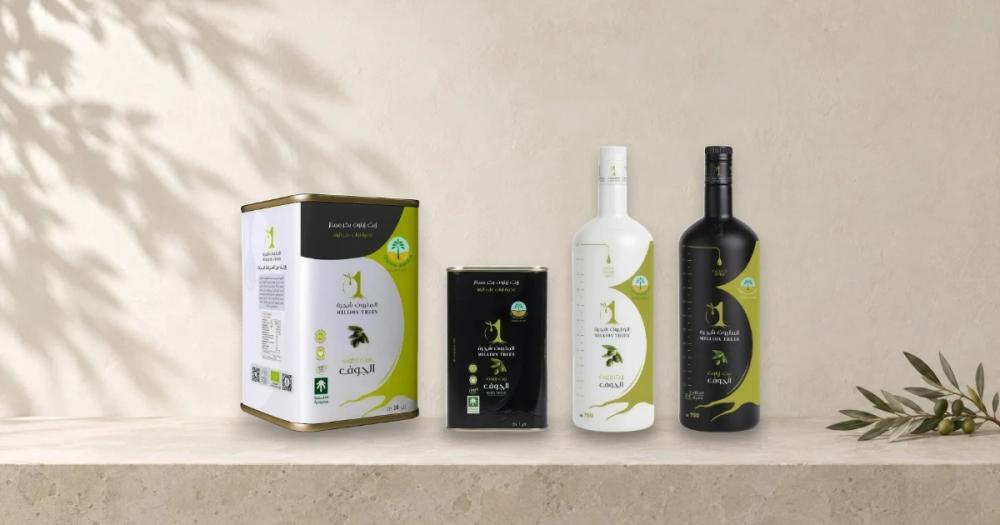
Our Million Trees Olive Oil comes from our farms in Al-Jawf, a region that boasts over 23 million olive trees, according to the Saudi Press Agency (2024). We cultivate our trees using modern, intensive planting methods in straight rows running from north to south. We harvest the olives mechanically and transport them directly to our on-farm press, where the oil is cold-pressed using centrifugal force. We package it in metal cans for those who purchase a full season's supply for daily cooking, and in dark glass for those who prefer it as a table oil or a presentable gift. You can find metal cans ranging from 1 to 16 liters in the Al-Jawf Olive Oil section , dark glass bottles from 100 to 750 ml in the Glass section , and our special harvest line in both cans and dark glass.
For those interested in learning more about the nature of the oil itself, we explained in our Al-Jawf Olive Oil Guide how the harvest date affects its color and strength. The Certifications and Awards page showcases our Organic Agriculture Certificate from the Ministry of Environment, Water and Agriculture, our Food and Drug Authority license, our ISO 22000 and HACCP certifications, and our international awards, including the Gold Medal at the 2024 Dubai International Olive Oil Competition in the Ultra Premium category.
Frequently Asked Questions
Which is better for storing olive oil, glass or tin?
For long-term storage and large quantities, lined tin is best because it completely blocks light and is shatterproof. For everyday use on the table and for gifts, dark glass is excellent, provided it is kept away from direct light. Both do not allow oxygen to pass through their walls.
Does green glass protect olive oil from light?
It offers much better protection than clear glass, but amber-brown glass blocks a wider range of harmful light. The darker the green, the better the protection, and most importantly, the bottle should be stored in a dark cabinet.
Does olive oil react with tin cans?
Food-grade cans are lined with a layer that prevents the oil from coming into contact with the metal, thus preventing a reaction. The problem occurs in cans that are severely dented or rusty, or in unlined metal containers such as iron and copper, and these should be avoided.
Can olive oil be stored in a plastic bottle?
The oil has a short shelf life and will be consumed within weeks, but the plastic allows oxygen to seep in slowly and is mostly transparent. We do not recommend it for long-term storage, and do not use empty water bottles to transfer the oil from the can.
Why does the taste of oil in a clear bottle change so quickly?
Because the chlorophyll in the oil absorbs light and converts dissolved oxygen into an active form that attacks fats very quickly, the rancid smell appears sooner. Storing the clear bottle in its case or in a dark cupboard solves most of the problem.
Will the oil be damaged if it remains in the car during the summer?
Yes, the temperature inside the cabin in the sun can exceed 60 degrees Celsius, which greatly accelerates oxidation. Transport the oil in the air-conditioned cabin, make it the last thing you buy, and store it in a dark cabinet as soon as you arrive.
The packaging isn't just a decorative detail; it determines how long the oil will remain fresh from the press. Choose opaque containers for storing large quantities, and dark glass for tableware and gifts. Keep the oil away from sunlight and heat, both during transport and in the kitchen. For more details on storage methods at home, refer to the guide on how to store olive oil .