
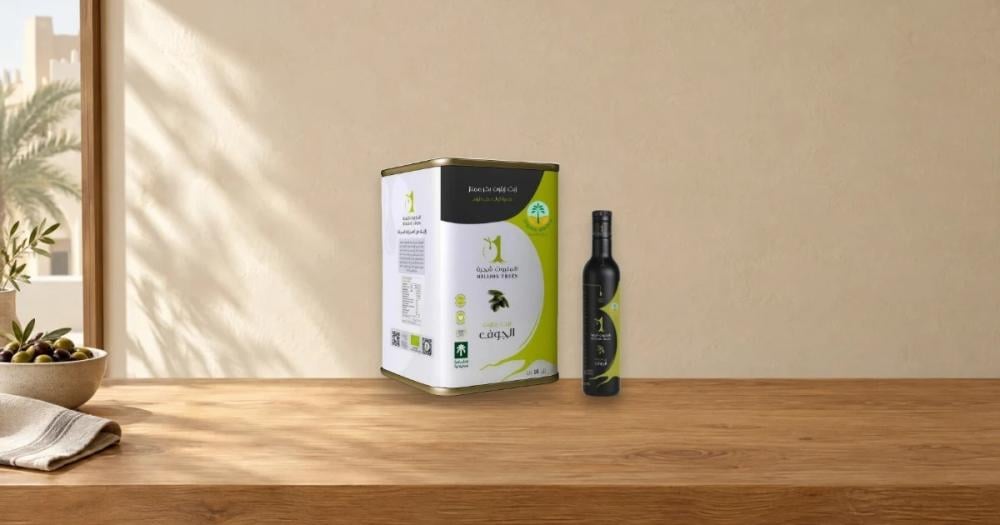
Olive oil doesn't spoil like milk or bread, so many people assume it lasts indefinitely. However, the reality in Saudi kitchens is different: the summer heat, the shelf next to the stove, and a container that's been open for a whole season all contribute to the oil gradually losing its green flavor and aroma, until it becomes rancid without you even noticing. And oil that has lost its quality simply won't give your salad or hummus the taste you paid for.
This guide is practical from beginning to end. You will learn the ideal conditions for storing oil, the places to avoid in the kitchen, when refrigeration is beneficial and when it is detrimental, how long oil lasts sealed and uncovered, how to test oil with your nose to see if it has gone rancid, and the strict rule for storing garlic and herb-flavored oils.
In short: Store olive oil in a dark place between 15 and 20 degrees Celsius, in an airtight container away from the stove and windows. Sealed oil retains its quality until its "best before" date, which is usually between 18 and 24 months from bottling, and has its best flavor in the first year after harvest. Once opened, consume it within one to three months for optimal taste. Homemade oil flavored with garlic or fresh herbs should be refrigerated and consumed within a few days. This is a non-negotiable food safety rule.
Ideal conditions for storing olive oil

Oil quality deteriorates due to oxidation, and oxidation requires three elements to accelerate it: light, oxygen, and heat. Each storage rule aims to reduce one or more of these elements.
- A temperature between approximately 15 and 20 degrees Celsius: this range is cool enough to slow oxidation and warm enough to prevent the oil from becoming cloudy or solidifying. More important than the exact temperature is consistency, as daily fluctuations between cold and hot temperatures are more damaging to the oil than a consistently moderate temperature.
- Darkness: Light, especially sunlight and ultraviolet rays, greatly accelerates the oxidation of oil due to its natural chlorophyll content. Therefore, opaque containers and sealed tanks are preferred.
- Tight seal and small air gap: Replace the cap immediately after pouring, and choose a container size that suits your consumption so that the oil does not remain in a half-empty container for months.
- Keep away from strong odors: Oil absorbs odors, so do not place it near detergents, open strong spices, or fuel in the warehouse.
If you are unsure about the type of packaging itself, we have compared the types in detail in the article "Storing Olive Oil in Glass or Tin" .
Places where oil is not stored in the Saudi kitchen

The kitchen is one of the hottest rooms in our homes, especially in the summer and while cooking lunch. In many homes, we see oil placed where it's most easily accessible, which is often the worst place for it. The following table summarizes the most common places and the dangers associated with them.
| Storage location | Source of danger | The ruling |
| A shelf next to or above the stove | High and fluctuating temperatures every day while cooking | Avoid it, or put in a small container that will expire within weeks. |
| On top of the refrigerator or microwave | Warm air is constantly coming out of the engine and appliances | Unsuitable, even though it seems like a remote place. |
| windowsill or shelf exposed to the sun | Direct sunlight and high heat at midday | Worse still, especially for clear glass. |
| Under-sink cabinet | Humidity and detergent odors, and sometimes a nearby water heater | Not suitable for storage |
| Rooftop or external annex storage | Summer temperatures could exceed 40 degrees for weeks | Storing tanks and large quantities of stock is prohibited |
| An enclosed inner cupboard away from the stove | Low risk if the house is air-conditioned | The preferred location for both sealed and opened containers |
| refrigerator | Cloudiness and condensation of moisture upon repeated discharge | Acceptable in specific cases, but not a daily option |
The rule of thumb from the table: the coldest, darkest cupboard in the house is where the stock is, and only one small package is near the stove, because it will be finished before the heat affects it.
Be careful of enclosed houses in the summer.
When traveling in the summer and turning off the air conditioning, the temperature in your apartment can rise above 40 degrees Celsius for weeks. If you have a large supply of oil, move it to the coolest room inside before you travel, or leave the air conditioning in one room running at a moderate temperature, or store sealed containers in the refrigerator while you are away.
The refrigerator: When is it beneficial and when is it harmful?
Refrigeration does slow down oxidation, so a refrigerator seems like an ideal solution. However, there are aspects you should be aware of before transferring oil to it.
Why does oil turn cloudy in the refrigerator?
Olive oil is a mixture of different fats, some of which crystallize at low temperatures. Cloudiness often begins when the temperature drops below approximately 10 degrees Celsius, and at normal refrigerator temperature (around 4 degrees Celsius), the oil may become thick or semi-solid. This is a natural physical change that disappears completely when the oil returns to room temperature and does not affect its quality. It's important to note that the so-called "refrigerator test" for detecting adulteration is unreliable, as solidification depends on the oil's composition and the type of olives. We have explained the correct methods in our guide to distinguishing between genuine and adulterated olive oil .
When is a refrigerator a good option?
- For storing sealed containers as a backup in a house where there is no cool place, or while traveling in the summer.
- To preserve homemade oils flavored with garlic or fresh herbs, the refrigerator is mandatory, not optional, as we will explain.
When does the refrigerator cause harm?
- Taking the bottle out and putting it back in daily causes water vapor to condense inside the container and on its nozzle, and the moisture damages the oil.
- Frozen oil is impractical for pouring over beans or salad, so you have to leave it out until it melts.
- The refrigerator is full of odors, and the loose lid allows them to transfer to the oil.
Practical solution: The sealed stock can go into the refrigerator when needed, while the daily bottle stays in a dark cupboard outside.
How long does olive oil last, sealed and unsealed?

Most companies include a "best before" date on the bottle, which is typically between 18 and 24 months from the bottling date. This date means that the sealed and properly stored oil retains its advertised characteristics until that time, but it doesn't guarantee a consistent flavor throughout. The oil is at its best during the first year after harvesting, then its sharpness and pleasant bitterness gradually diminish.
Read the harvest date if available.
The bottling date alone doesn't tell you exactly when the oil was pressed; it might be oil from a previous season. If the label mentions the harvest season, that's the most accurate information. In Al-Jawf, the harvest typically lasts from autumn to early winter, so oil purchased in winter and spring from the new season is the freshest.
The following table compiles suggested consumption periods for each case; these are practical estimates of best taste and not limits of food safety.
| Oil condition | Proposed consumption period | Practical observation |
| A sealed package in a dark and cool place | Until the "best before" date, usually 18 to 24 months from packaging. | Best flavor during the first year after harvest |
| Open bottle or small can | From one to three months | Shorter in the hot kitchen or near the stove |
| A large open can without emptying | Ideally within two to three months | The air gap expands with each use. |
| Oil poured into small, filled, and sealed containers | Several months, and each package is treated as an open bottle after opening. | The best way to store 8 and 16 liter tanks |
| Unfiltered oil | Preferably during the first months after sunset | The sediment may ferment if it remains for too long. |
| Homemade oil with garlic or fresh herbs | Refrigerate immediately, within approximately four days | Food safety rule: Do not leave at room temperature. |
Note that the intervals shorten the more the oil is exposed to air or contains other ingredients, and the only case that is related to safety and not taste is homemade flavored oil.
How do you know if oil has gone rancid?
Rancidity is an advanced stage of oxidation and is one of the sensory defects identified by the International Olive Council (IOC) in its sensory evaluation of olive oil, along with other defects such as a fermentation odor from sediment, a musty smell, and a vinegary taste. You don't need a lab to detect it; your nose will do.
Home smell test
- Pour a tablespoon of oil into a small glass cup.
- Cover the cup with your palm and warm it between your hands for a minute or two, because the slight heat releases the odors.
- Stir the oil in the cup, then lift your palm and smell it directly.
- The smell of good oil is reminiscent of cut grass, olive leaves, green apples, or tomatoes, depending on the type.
- Rancid oil smells reminiscent of wax crayons, putty, old nuts and walnuts, or paint.
- Take a small sip: Rancid oil leaves a heavy, greasy sensation in the mouth without the fruity flavor, and without the slight burning sensation in the throat that characterizes fresh oil.
If you have a new oil, compare it to this one, as a direct comparison reveals the difference more clearly than any description. Understanding the differences between oil grades also helps you interpret the result, and we explained this in the section on the difference between extra virgin, virgin, and refined olive oil .
Unfiltered oil and sediment
Unfiltered oil contains fine particles of olive pulp and tiny water droplets, which is why it appears darker. Over time, these particles settle at the bottom of the container, and if left for too long, they may ferment and give the oil an unpleasant odor. Therefore, consume unfiltered oil within the first few months after pressing. If you notice a thick layer of sediment at the bottom, carefully pour the clear oil into a clean, dry container and discard the sediment.
Common storage mistakes
Adding new oil over old oil
A common mistake is to refill a partially empty bottle with new oil. This is incorrect because the remnants of old oil contain oxidation products that accelerate the oxidation of the new oil, and the slimy film on the bottle's walls and bottom is already oxidized. Wash the container with hot, soapy water and dry it thoroughly before refilling, or use a different container.
Buying more than you consume without a plan
The larger can offers savings per liter, but it needs to be emptied or divided if your consumption is slow. We've calculated this numerically in our guide to choosing between a liter can and a 16-liter can .
What do you do with oil that has lost its flavor?
Distinguish between two cases. Oil that has simply become dull, without a rancid smell, is still suitable for cooking: use it to sauté onions for kabsa, roast vegetables in the oven, or for cooking where the oil's flavor isn't the primary focus. Reserve fresh oil for salads, hummus, and za'atar. However, oil that has become rancid, smelling of wax and old nuts, should not be used in cooking, as its odor will permeate the entire dish. It can be used for non-food purposes, such as polishing wooden utensils or lubricating door hinges.
Garlic and herb-flavored oils: a food safety rule
Homemade garlic, basil, or rosemary oil is delicious on pastries and salads, but it poses a real risk if stored improperly. Garlic and fresh herbs may carry spores of Clostridium botulinum bacteria, the cause of botulism, from the soil. When immersed in oil, they are in an oxygen-free environment, and garlic has low acidity. At room temperature, these spores can become active and produce their toxin without the oil changing its appearance, smell, or taste.
No exceptions: Homemade garlic or fresh herb oil should be prepared in small batches, refrigerated immediately, and consumed within a few days (USDA food safety guidelines recommend about four days), or frozen. Never leave it on a kitchen shelf at room temperature.
- Completely dried herbs and spices, such as dried thyme and dried chili peppers, are much less risky, but it is also preferable to prepare them in small quantities.
- The thyme and oil mixture for breakfast is prepared for immediate use and is not stored mixed for weeks.
- Commercially prepared flavored oils undergo processing or acidification that makes them different from those prepared at home, so don't judge them harshly.
How do we handle Million Tree Oil?

Our Million Trees Olive Oil comes from our farms in Al-Jawf, a region that boasts over 23 million olive trees, according to the Saudi Press Agency (2024). We cultivate our trees using modern, intensive planting methods in straight rows running from north to south. We harvest the olives mechanically and transport them directly to our on-site press, where the oil is cold-pressed using centrifugal force. We advise those who purchase large quantities to empty them into small, dark-colored containers upon opening, and those who prefer to use the oil at the table to choose a small glass bottle to finish it at its best.
You can find metal cans ranging from 1 to 16 liters in the Al-Jawf Olive Oil section , dark glass bottles from 100 to 750 ml in the Glass section , and our Special Harvest line in cans and dark glass. The Certifications and Awards page showcases our Organic Agriculture Certificate from the Ministry of Environment, Water and Agriculture, our Food and Drug Authority license, our ISO 22000 and HACCP certifications, and our international awards, including the Gold Medal at the 2024 Dubai International Olive Oil Competition in the Ultra Premium category. To understand what acidity means in the analysis certificates, please refer to the Olive Oil Acidity Guide.
Frequently Asked Questions
What is the best way to store olive oil at home?
Store in a tightly sealed, opaque container, inside a dark cupboard away from the stove and window, at a temperature between 15 and 20 degrees Celsius. Choose a size that you will finish within one to three months of opening.
Is it okay to store olive oil in the refrigerator?
You can use sealed, spare bottles if you don't have a cool place at home, but it's not necessary for a daily bottle. The oil will become cloudy and thicken, but this will disappear when it returns to room temperature and doesn't affect its quality. However, frequent use can cause moisture inside the bottle.
How long does olive oil last after it's opened?
For best flavor, it's best enjoyed one to three months after opening, and less often in spicy cuisine. After this time, it's generally still safe to cook as long as it doesn't develop a rancid smell, but its flavor will diminish.
Does olive oil expire if it exceeds its expiry date?
The "best before" date pertains to quality, not direct safety. Oil after this date may be dull or rancid depending on storage conditions, so test it by smell and taste before use, and discard if it smells of wax or old nuts.
Why are there sediments at the bottom of olive oil?
Often, because the oil is unfiltered or poorly filtered, olive pulp particles settle over time. While the sediment isn't a defect initially, it's best to consume this oil early and discard any clear oil that has accumulated.
Can homemade garlic oil be stored outside the refrigerator?
No. Garlic or fresh herbs submerged in oil at room temperature are an environment that may allow botulism bacteria to grow without any change in taste or smell. Refrigerate immediately and consume within a few days, or freeze.
Storing olive oil doesn't require special tools, just three things: a dark, cool place, a lid that's replaced immediately after pouring, and a size appropriate for your household's needs. And with the safety guidelines for flavored oils, you can ensure that the oil remains on your table with the same taste it had when it left the press.