
Many people search for "best olive oil in Saudi Arabia" hoping for a single name, only to find conflicting rankings, most of which don't explain the basis for the ranking. The truth is, the best oil for a breakfast salad might not be the best for everyday cooking, and the oil that won an award three seasons ago isn't necessarily the oil on the shelf today.
Therefore, in this guide we do not provide a list of names, but rather an evaluation method that you can apply to any package yourself: seven criteria to check before buying, a correct way to calculate the price, an understanding of what awards and certificates mean, a fair comparison between local and imported oil, and then the most suitable choice according to the use in your home.
In short: The best olive oil is extra virgin olive oil from a recent harvest, with a known origin and producer, packaged in a light-protected container, and accompanied by analysis results for a specific batch. Compare prices per liter, not per bottle. Locally produced oil benefits from shorter transport distances and less heat exposure. The right choice depends on the intended use: early harvest for salads, and a larger, balanced bottle for everyday cooking.
Why is there no single answer to the question of the best olive oil?
Olive oil is an agricultural product that varies from season to season, and its quality after pressing depends on storage and transportation. The same bottle from the same brand might be excellent in winter but spoil in summer if it spends weeks in a hot warehouse. Therefore, the fixed ranking of brands assumes a stability that doesn't actually exist.
Furthermore, tastes truly differ. Some prefer a sharp, green oil that tingles the throat, while others prefer a smooth oil that doesn't overpower the flavor of hummus or labneh. Both can be excellent, flawless virgin olive oils. What can be agreed upon is a minimum quality standard; anything beyond that depends on personal taste, intended use, and budget.
The seven criteria for evaluating any olive oil
Degree
Always start with the grade. "Extra Virgin Olive Oil" is the highest grade according to the International Olive Council's standards, requiring an acidity level not exceeding 0.8%, no taste defects, and a fruity note. Below it, "Virgin," "Blended Olive Oil," and "Pollen Olive Oil" vary in taste and quality. If the grade isn't clearly stated, there's no need to continue the evaluation.
Harvest date
Oil gradually loses its flavor and phenolic compounds from the moment it's pressed, so its actual age matters more than its expiration date. Opt for a bottle that indicates the harvest season, and choose oil from the current or previous season. The expiration date is often calculated from the bottling date, so it doesn't tell you when the oil was picked.
Origin traceability
The more you know about the source of the oil, the easier it is to judge it: the region, the farm or producer, and where it was pressed and bottled. The phrase "bottled in" does not mean that the oil was grown there, and the phrase "a blend of oils from different countries" means that the oil was collected from multiple sources, none of which can be traced.
Package
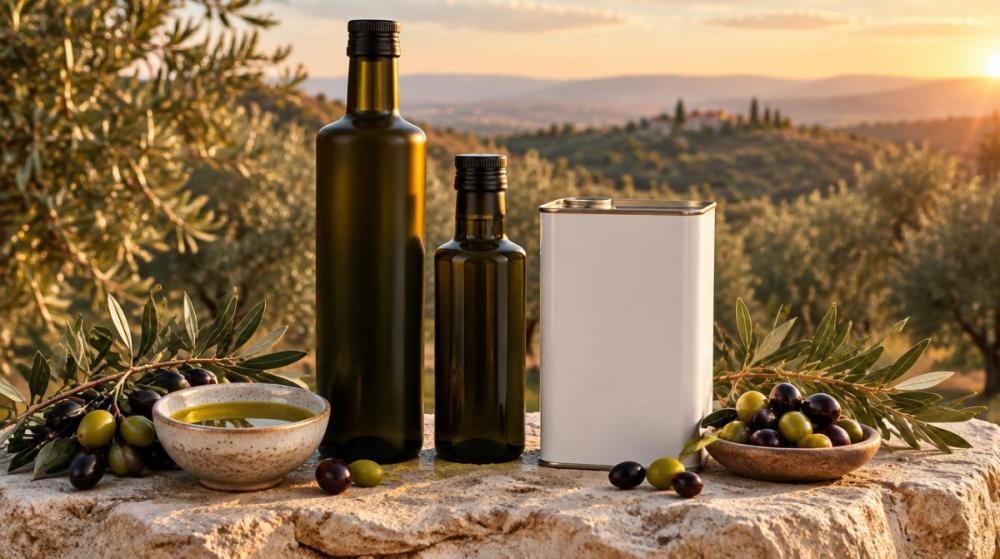
Light, heat, and air accelerate the oxidation of olive oil. Metal cans completely block out light and are suitable for large quantities, while dark glass is suitable for table use if stored in a dark cupboard, and clear plastic is the least desirable option. We discussed this comparison in detail in our article "Olive Oil in Glass vs. Metal Cans ."
Certificates of Analysis
The analysis results are the only numerical proof of the grade. A useful certificate includes the laboratory name, the date of analysis, and the batch or season. It should also include more than just acidity: peroxide value, UV readings K232 and K270, and preferably, the fatty acid and sterol composition. We explained these indicators and what they reveal in the article "How to Tell Genuine Olive Oil from Adulterated ," and specifically regarding acidity, in the article "Acidity of Olive Oil ."
The taste
Fresh extra virgin olive oil has a distinct fruity aroma, a bitter aftertaste on the back of the tongue, and a slight stinging sensation in the throat after swallowing, varying in intensity depending on the variety and harvest time. Any odor resembling wax, old nuts, fermented olives, clay, or vinegar are defects that disqualify the oil from being considered premium, regardless of its classification.
Price per liter
The price printed on the bottle isn't a reliable comparison tool because sizes vary. Divide the price by the number of liters, then compare bottles of similar grade and freshness. A significantly lower price than usual for extra virgin olive oil warrants caution, as the production cost of this oil has a minimum threshold that cannot be exceeded for long.
The following table compiles the seven criteria into a quick checklist to take with you to the store.
| Standard | What you are looking for | warning sign |
| Degree | The phrase "extra virgin olive oil" verbatim | "Pure olive oil" or "light" or "olive oil only" |
| Harvest date | The current or past harvest season is written on the packaging. | Expiry date only, with no mention of season. |
| Trace origin | Region, producing entity, and place of era | "Packed in" without specifying the place of cultivation, or a mixture of unnamed countries |
| Package | A tightly sealed metal or dark glass can | Clear plastic or display under light and in a hot place |
| Certificates of Analysis | Recent results from a specific batch of a named laboratory | Certificate without a date, or old, or limited to acidity |
| The taste | A fresh fruit aroma with a balanced bitterness and tang | Absolutely no odor, rancidity, fermentation, or metallic taste. |
| Price per liter | Reasonable price compared to the extra virgin olive oil market | A significantly lower price than usual or a large, permanent discount |
If the package meets the first six criteria, then the choice becomes a matter of taste and budget. However, if it falls short in terms of grade, analysis, or taste, a low price cannot compensate for it.
How to calculate the price per liter and compare fairly
Take, for example, the prices of the "Million Trees" line at the time of writing, which include tax and may change with special offers: a 500ml glass bottle for 45 riyals means 90 riyals per liter, a 4-liter container for 235 riyals means about 59 riyals per liter, and a 16-liter container for 596 riyals means about 37 riyals per liter. The oil is the same, and the price difference per liter is more than double between the smallest and largest containers.
However, a lower price per liter doesn't always mean a more economical choice. If you buy 16 liters and only consume one liter per month, the open container will remain for a long time, and the oil's flavor will diminish before it's finished, unless you divide it into smaller, airtight containers immediately after opening. The best approach is to choose the largest size you can consume or divide it within two to three months of opening.
When comparing two brands, compare bottles of the same grade and from roughly the same season. Comparing extra virgin olive oil from the current season to oil from an unknown season is unfair, even if the volume is identical.
Local or imported oil: modernity, shipping, and heat
Imported olive oil from the Mediterranean undergoes a lengthy process before reaching your kitchen: storage in the country of origin, sea freight that can take weeks, waiting at the port, then overland transport, storage at the distributor, and display in the store. The oil may be shipped in bulk in tanks and then bottled upon arrival, bearing a recently bottled date that is actually older. During the summer months, temperatures inside containers and unrefrigerated warehouses can rise to levels that accelerate oil oxidation.
Locally produced oil shortens this chain. The distance between the press and the consumer is shorter, the number of loading and unloadings is reduced, and it's easier to know the harvest season and the farm. However, it's only fair to say that imported oil, if transported and stored carefully, may arrive in high quality, while local oil left in a hot warehouse loses its quality just as quickly. The real advantage of local oil lies in its shorter delivery time and ease of verification, but the final judgment rests with the seven criteria.
For those who want to know about the nature of the oil produced in the north of the Kingdom, we have written a complete guide about Al-Jawf olive oil, explaining the effect of climate and harvest time on its taste.
Awards and certificates: What they mean and what they don't mean
Awards and certificates are useful information if you understand them within their limits, and misleading if you treat them as an absolute guarantee.
- International competition awards: These typically evaluate a sample submitted by the producer from a specific batch in a particular season, judged by trained tasters. An award signifies that the sample was excellent, but it doesn't automatically apply to subsequent seasons. Many competitions also award medals to each sample that surpasses a certain score, rather than ranking the participants, so always inquire about the season for which the award is being given.
- Laboratory analysis certificate: The most useful document for the consumer, provided that it is up-to-date, mentions the batch and laboratory, and includes several indicators, not just acidity.
- Organic certification means that the farm has adhered to specific standards in the use of fertilizers and pesticides, and it is issued by an accrediting body. It is a certification of the production method, not the taste or grade of the oil; oil can be both organic and virgin.
- Food safety and quality management system certifications: These include certifications for food safety management systems in factories. They indicate that the facility follows organized procedures for hygiene and traceability, but they do not measure the quality of the oil itself.
The correct reading is to combine these pieces of information: a recent award with a recent analysis with a clear harvest season gives you a much closer picture than any one of them alone.
Best choice based on usage
Once the minimum quality requirements are met, the more precise question becomes: which oil is best suited for this specific use? The following table provides practical recommendations for typical Saudi household uses.
| Usage | The appropriate type | Package and size | Practical observation |
| Salads, hummus, fava beans, and dips | Excellent virgin dates from an early or mid-season harvest | Dark glass 500 or 750 ml | The flavor is fully realized and the oil is raw, so choose the newest. |
| Daily cooking and sautéing | Excellent, well-balanced flavor | 2 or 4 liter can | It withstands the heat of home cooking, and the price per liter is important here. |
| deep frying | Premium or budget-friendly virgin | large box | Do not reuse frying oil too often. |
| Gifts and occasions | Early harvest or a distinctive line with a clear season | An elegant glass bottle or a moderately sized box | Attach a card to remind you of the harvest season and how to store it. |
| Family stock for the season | Bakr Mumtaz from the new season | 8 or 16 liter can | Divide it after opening into small, airtight containers. |
| Who is trying virgin olive oil for the first time? | Late harvest or soft-tasting variety | 500 ml bottle | Start with the milder flavors, then move on to the stronger ones. |
The table shows that many households need two containers, not one: a small bottle of sharp cooking oil, and a larger can with a lower price per liter for cooking.
Common mistakes when buying olive oil
- Choosing based on color, although color depends on the variety and harvest date and does not indicate quality.
- Buy the largest can because it is the cheapest per liter, then leave it open for many months near the stove.
- Relying on the phrase "first cold press" instead of looking for the degree and harvest season, and we have explained its true meaning in the article "first cold press" .
- The acidity number is sufficient, although it does not reveal whether the oil is refined or tell the age of the oil.
- Trusting in an award without knowing which season it belongs to.
- Leaving the oil in the car after purchase in the summer, even for just a few hours.
How do we apply these standards to the million trees?
We grow olives in the Al-Jawf region, and we offer the basic “Million Trees” line in glass boxes and bottles in sizes from 500 ml to 16 liters, the special harvest line of early-season fruits for those who want a sharp green flavor on the table and in gifts, and the “Nasser Olive” line at a lower price for daily use.
Because the seven standards begin with transparency, we publish our analysis certificates, awards, and membership certificate on the Certificates and Awards page . You can compare sizes and prices yourself in the Al-Jawf Olive Oil section .
Frequently Asked Questions
What is the best olive oil in Saudi Arabia?
There is no single brand that is best for everyone and for every use. The best option is extra virgin olive oil from a recent harvest, of known origin, stored in a suitable container, with up-to-date analysis results. Then, taste, intended use, and budget come into play when choosing between oils that meet these criteria.
Is the most expensive oil always better?
No. The price is influenced by the brand, packaging, import costs, and marketing, not just the quality. However, the very low price compared to the extra virgin olive oil market warrants caution, as its production costs are not easily reduced.
Is locally produced olive oil better than imported olive oil?
Its most obvious advantage is the short distance between the press and the consumer, its minimal exposure to heat during transport, and the ease of identifying its season and farm. Final quality depends on the grade, analysis, and storage, all of which are checked in both cases.
Does the award mean that every package from this brand is excellent?
The award typically pertains to a sample from a specific batch and season. While it's a positive indicator of the product's potential, it doesn't replace knowing the season of the batch you're purchasing and the results of its analysis.
What should the acidity level be for the best olive oil?
The International Olive Council sets the maximum acidity level for extra virgin olive oil at 0.8%. Low acidity within this limit is a good sign, but comparing two oils with a slight difference in acidity is less important than the oil's freshness, taste, and other analytical indicators.
What is the most suitable size for an average Saudi family?
It depends on actual consumption, but the general rule is to choose a size that you finish or divide within two to three months of opening. Many families combine a small table bottle with a 2 or 4-liter container for cooking.
Take this seven-criteria list with you the next time you're standing in front of an olive oil shelf or browsing an online store. You'll find that most options are eliminated in a minute, and what remains you can confidently choose from according to your taste and needs.