
The acidity level is the first thing many buyers in Saudi Arabia ask about, and brands compete on it in their advertisements: 0.5%, then 0.3%, then 0.2%. But few buyers know exactly what this number measures, and why an oil with very low acidity might be of lower quality than one with slightly higher acidity.
This guide explains free acidity from its chemical basis, the reasons for its increase, and its official limits for each category. It then presents you with the rest of the indicators that complete the picture, teaches you to read the analysis certificate line by line, suggests questions that reveal the seriousness of the seller, and refutes the myths spread about "tasting" acidity.
In summary: Free acidity is the percentage of fatty acids that have separated from the oil molecules due to fruit damage or delayed pressing. It is measured in the laboratory and not tasted. The limit for extra virgin oil is 0.8%, and for virgin oil, it is 2%. Low acidity is a necessary but not sufficient condition, as refined oil has an acidity of 0.3% or less. To assess quality, consider the peroxide content, UV index, and the official taste result.
What is free acidity from a chemical perspective?

Olive oil is composed mostly, about 98%, of molecules called triglycerides, each molecule consisting of a glycerol structure to which three fatty acids are bonded. The predominant fatty acid in olive oil is oleic acid, which, according to the International Olive Council standard, ranges between 55% and 83% of the total fatty acids.
When fruit cells are damaged, the oil comes into contact with enzymes called lipases, which are present in the fruit itself and in fungi and bacteria that grow on the damaged fruit. These enzymes, in the presence of water, break the bond between glycerol and fatty acids in a reaction called hydrolysis, releasing unbound "free" fatty acids. The ratio of these free fatty acids is what we call acidity.
Acidity is measured in the laboratory by titration: a known weight of oil is dissolved in a solvent, and a known concentration of alkaline solution is added until neutralization occurs. The percentage of free fatty acids is then calculated from the amount of alkali consumed. The result is recorded as grams of oleic acid per 100 grams of oil, as it is the predominant acid. Therefore, when you read "acidity 0.3%," it means that every 100 grams of oil contains 0.3 grams of free fatty acids, calculated as oleic acid. This number is unrelated to pH or sourness, as oil does not contain enough water to have a pH measured in the first place.
Why does acidity rise?

Acidity is mostly determined before the olives enter the press, and anything that damages the fruit or delays pressing it raises it.
Damaged fruit
Olives infested with olive fruit flies, damaged by rough harvesting with sticks, exposed to frost, or left lying on the ground for days, all have ruptured cells and begin to decompose. Therefore, good farmers separate fallen olives from those picked from the tree and do not press them together.
The delay between picking and pressing
Olives are a living fruit that continues to breathe after being picked, and the longer they are left to ferment, the more active the enzymes become. Storing the fruit in stacked bags or large piles raises its internal temperature and traps moisture, accelerating spoilage. The practice in quality-conscious olive presses is to press the olives within 24 hours of picking, ideally on the same day, transporting them in ventilated plastic crates.
fermentation
When fruit is left piled up for days, fermentation processes driven by microorganisms begin, increasing acidity and causing sensory defects such as fermentation and a vinegary taste. This illustrates the relationship between acidity and taste: fermented oil generally has high acidity, but the reverse is not always true; an oil may exhibit sensory defects even with an acidity below 0.8%.
Poor oil storage
After pressing, the acidity rises much more slowly, provided the oil is clean. The presence of water and sediment in unfiltered oil, or storage at high temperatures, allows hydrolysis to continue slowly. Filtered oil stored in a cool, sealed tank, however, remains relatively stable in acidity for months, and signs of aging appear in other indicators, which we will explain later, rather than in acidity.
pH limits for each category, and why a low number isn't enough
The International Olive Council has set an upper limit for acidity in each category, and European regulations follow almost the same limits with differences in the ordinary virgin and light virgin categories. The following table summarizes these limits with their corresponding peroxide number.
| Category | Upper limit of free acidity | Upper limit of peroxide | note |
| extra virgin olive oil | 0.80% | 20 milliequivalents of oxygen per kg | It must have zero defects in the official taste test. |
| virgin olive oil | 2.0% | 20 milliequivalents of oxygen per kg | Accepts minor sensory imperfections with a noticeable fruitiness |
| Extra virgin olive oil | 3.3% | 20 milliequivalents of oxygen per kg | An international category not recognized by European regulations |
| Virgin oil | More than 3.3% (more than 2% in Europe) | Not specified because it is not edible. | It is sent to refining before any consumption. |
| refined olive oil | 0.30% | 5 milliequivalents of oxygen per kg | Free acids were chemically removed. |
| Olive oil (refined with virgin) | 1.00% | 15 milliequivalents of oxygen per kg | The category sold under the names Pure, Light, or Classic |
| olive pomace oil | 1.00% | 15 milliequivalents of oxygen per kg | Solvent extracted, then refined and mixed with virgin |
The lowest acidity in the table is not for extra virgin but for refined oil, and this observation alone is enough to understand why acidity is not a suitable sole measure of quality.
Refined oil has less acidity than any virgin oil.
In refining, free acids are neutralized with an alkaline solution and removed, resulting in oil with an acidity of 0.1% or 0.2%, even if it originated from fermented, high-acid oil with an acidity of 5%. If you considered only this number, you might assume that refined oil is superior to extra virgin olive oil, when in fact it has lost its flavor and most of its natural components. This is why European regulations only permit the listing of acidity on olive oil labels if it is accompanied by the peroxide value, wax content, and UV index, to prevent the acidity alone from becoming a misleading marketing tool.
Acidity does not reveal the age of the oil.
Extra virgin olive oil pressed at an acidity of 0.25% may retain roughly the same level after a year and a half, but it will have lost most of its flavor and begun to oxidize. The acidity reflects the state of the olives at the time of pressing, while what happens to the oil afterward is revealed by indicators of oxidation and taste.
Light refining and blending
A common adulteration method involves treating defective olive oil by removing its odor at a relatively low temperature to conceal its flaws, then mixing it with virgin olive oil and selling it as extra virgin. This oil may have a good acidity level, but more precise analyses, such as those for ethyl esters and stigmasterol, will reveal its adulteration. Methods for detecting these practices can be found in the guide to distinguishing between genuine and adulterated olive oil .
Other indicators that complete the picture
Peroxide number
It measures the primary compounds of oxidation, i.e., the first stage of the oil's reaction with oxygen. Its limit in extra virgin olive oil is 20 milliequivalents of oxygen per kilogram, and good-quality fresh oil usually has much lower figures. A higher reading indicates that the oil has been exposed to air, light, or heat. However, the peroxides themselves decompose over time into secondary compounds, so the figure may decrease in oil that has undergone advanced oxidation. This is why it is always read in conjunction with UV coefficients.
UV absorption coefficients: K232, K270, and ΔK
The absorption of oil by ultraviolet light is measured at specific wavelengths because oxidation products absorb these wavelengths. The K232 index is associated with primary oxidation products, and its value in extra virgin is 2.50. The K270 index is associated with secondary oxidation products and compounds generated during refining, and its value is 0.22. ΔK measures the shape of the absorption curve around 270 nm, and its value is 0.01; a high ΔK value is a strong indicator of the presence of refined or processed oil in the blend.
polyphenols
Natural phenolic compounds are responsible for the bitterness and pungency of oil, and they slow its oxidation, thus prolonging its flavor. The international standard does not set a minimum level for these compounds, but many producers analyze them and report the concentration in milligrams per kilogram. These levels are higher in early-harvest and quick-pressed oils, decrease with long-term storage, and are almost absent in refined oils. When comparing two figures, ensure they were analyzed using the same method, as different analytical methods can yield different values for the same oil.
sensory assessment
It is conducted by a team of 8 to 12 trained tasters according to the methodology of the International Olive Council. Extra virgin olive oil requires a zero average defect score and a fruitiness score greater than zero. This test reveals what numbers alone cannot, such as a slight fermentation defect in oil with low acidity, the details of which we have explained in the guide to the differences between extra virgin, virgin, and refined olive oils .
Freshness indicators
Some national standards, such as the Australian Olive Oil Standard, use two additional indicators to measure oil age and heat exposure: the diglyceride content (DAGs) and the pyruvate content (PPP). Both change gradually with storage, giving an indication of oil age that acidity alone cannot. These indicators are not found on every certification, but their presence is a sign of a product that pays attention to detail.
How to read a certificate of analysis line by line

Before looking at the numbers, check the certificate header: the name of the laboratory, whether it is accredited (e.g., according to ISO/IEC 17025, or recognized by the International Olive Council), the date the sample was received, the date of analysis, and the batch number. A certificate that is three years old, or from a different batch than the one you are buying, doesn't tell you much about the package you have.
Then compare each line to the official limit. The following table explains the most important items that appear in certificates of excellent virginity.
| The indicator in the certificate | Excellent virgin limit | What it tells you |
| Free acidity | 0.80% maximum | Fruit safety and quick pressing on the day of production |
| Peroxide value | 20 milliequivalents of oxygen per kg | Primary oxidation by air, light, and heat |
| K232 coefficient | 2.50 maximum | Primary oxidation products, and increase with improper storage |
| K270 coefficient | 0.22 maximum | Advanced oxidation and the potential presence of refined oil |
| Delta K (ΔK) | 0.01 maximum | A sensitive indicator of the mixing of refined or processed oil |
| Ethyl esters of fatty acids (FAEE) | 35 mg per kg maximum | Fermented or damaged fruit, and light refining revealed |
| Sensory assessment (Panel Test) | The median for defects is zero and the median for fruitiness is greater than zero. | The final verdict on the cleanliness and flavor of the oil |
Truly premium oil not only stays below the limit but goes well beyond it. An acidity of 0.75% with 18% peroxide is a standard acceptable figure, but it leaves no room for storage changes until the oil reaches your kitchen.
More detailed certificates may include additional items such as waxes (limited to 150 mg/kg in extra virgin) and stagstadine (0.05 mg/kg), along with the composition of sterols and fatty acids. These items reveal the adulteration of pomace, refined, or seed oils, and their presence indicates a comprehensive analysis, not just a quick check.
Questions to ask the seller
- What is the official category of oil? The answer should be a specific name: extra virgin or virgin, not a generic phrase like "genuine" or "natural".
- When were the olives picked and when were they pressed? The harvest season is more important than the expiry date, because the expiry date is usually calculated from the packing date.
- Do you have a certificate of analysis for this particular batch? Please ensure that the batch number on the certificate matches the number printed on the package.
- Does the certificate include sensory evaluation? A certificate that only lists acidity and peroxide is not sufficient to prove the premium virgin category.
- From which farm or region did the olives come? A producer who knows the source of his fruit can control the timing of harvesting and pressing.
- How should oil be stored before bottling? A good answer: stainless steel tanks, sealed, in a cool place, preferably under an inert gas.
A reputable seller will answer these questions easily; avoiding them or simply repeating the acidity level is a red flag. Since home storage complements the product's process, review how to store olive oil at home to preserve its quality.
Common myths about tasting sourness
"A burning sensation in the throat is a sign of high acidity."
The opposite is more likely true. The burning sensation you feel in your throat after swallowing fresh oil comes from a natural phenolic compound called oleocanthal, which is considered a positive quality in formal taste. Free fatty acids do not cause this sensation, and highly acidic fermented oil is generally bland and without a burning sensation.
"Highly acidic oil tastes sour."
Free fatty acids do not produce a sour taste like lemon or vinegar, and no one can determine acidity with their tongue. What can be tasted are the defects that sometimes accompany their high levels, such as fermentation and cellulite; these are sensory defects with their own specific causes.
"Bitterness means the oil is bad."
The bitterness in early-harvest oil is a desirable characteristic stemming from polyphenols, and it gradually diminishes over the months. Oil completely free of bitterness is either pressed from very ripe fruit, aged, or refined.
"The lower the number, the better the oil, without limits."
The difference between 0.2% and 0.3% in wholesome extra virgin olive oil makes no noticeable difference in taste or quality, whereas a difference in peroxide or tasting can be decisive. A very low percentage without certification that includes other indicators proves nothing.
"Dark green color means less acidity"
The color comes from chlorophyll and carotenoids, and depends on the variety and degree of ripeness; it is not directly related to acidity. This is why professional tasters use colored glasses to conceal the oil's true color.
Million Tree Certificates

The acidity level in an advertisement is not enough to judge an oil, which is why we publish a full analysis certificate for each season. You can read it as explained here: the laboratory, the date of analysis, and other indicators alongside the acidity. Until then, our Certificates and Awards page displays our organic farming certificate from the Ministry of Environment, Water and Agriculture, our license from the Food and Drug Authority, our ISO 22000 and HACCP certifications, and our international awards, including the gold medal at the 2024 Dubai International Olive Oil Competition in the Ultra Premium category.
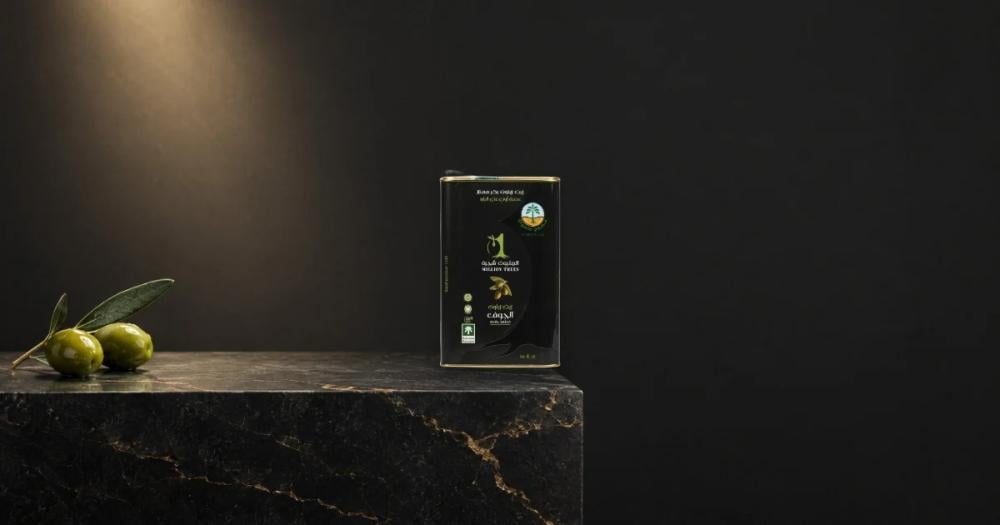
Our olive oil, produced in a million trees, comes from our farms in Al-Jawf, a region that boasts over 23 million olive trees, according to the Saudi Press Agency (2024). We cultivate our trees using modern, intensive planting methods in straight rows running from north to south. We harvest the olives mechanically and transport them directly to our on-site press, where the oil is cold-pressed using centrifugal force. This is particularly important for acidity, as the short distance between the tree and the press helps prevent the oil from rising too high. You can find metal cans ranging from 1 to 16 liters in the Al-Jawf olive oil section , dark glass bottles from 100 to 750 ml in the glass section , and our special harvest line in cans and dark glass.
Frequently Asked Questions
What is the appropriate acidity for extra virgin olive oil?
The standard limit is 0.8%, and freshly pressed oils from wholesome fruit often have significantly lower figures. However, there is no single ideal number; acidity is assessed in conjunction with peroxide concentration, UV coefficients, and sensory evaluation.
Is it possible to measure acidity at home?
There is no reliable home method. Some quick commercial tools give a rough estimate, but the only reliable number is the one issued by a laboratory using official methods. Refrigerator tests and flame tests do not measure acidity or establish a classification.
Does acidity increase after opening the package?
It rises very slowly in clean oil, and the most noticeable change after opening is oxidation, not acidity; peroxide levels rise and the flavor diminishes. Therefore, close the container tightly, store it in a cool, dark place, and consume it within a few months.
Why do some labels list acidity as 0.1% or less?
The number might be accurate for oil from perfectly good fruit that was pressed immediately, or it might contain some refining. The number alone isn't definitive; request the full certificate and ensure it includes sensory evaluation and Delta K.
Does high acidity make the oil inedible?
Oil with an acidity between 0.8% and 2% remains edible virgin oil, but in a lower category. Oil exceeding the normal virgin limit or exhibiting significant defects is classified as non-alcoholic and is not sold for consumption before refining.
What is the difference between acidity and peroxide?
Acidity measures the fatty acids that have separated through hydrolysis and is often determined by the state of the olives on the day of pressing. Peroxide measures the initial oxidation resulting from the oil's exposure to oxygen, light, and heat after pressing. The first indicates the olives themselves, while the second indicates the method of oil preservation.
The acidity rating offers a small window into the oil's quality, and it's useful once you understand its limits. Read it along with the rest of the certification, ask about the harvest season and batch number, and taste the oil yourself for fruitiness and purity. This way, you can judge the oil the way experts do.