
Olive oil is one of the most adulterated food products in the world because of the significant cost difference between extra virgin olive oil and cheaper oils, and because most consumers lack a quick way to verify its authenticity. However, many people use home methods to detect adulteration, such as using a refrigerator or a flame, which can lead some to believe they are dealing with adulterated oil or to suspect it is genuine.
This guide explains how adulteration actually happens, what signs to look for on the label, and in the smell and taste, how to taste oil at home in a way that closely resembles that of professional tasters, why common tests don't always prove anything, and what a laboratory can accurately reveal. After reading it, you'll know how to buy genuine oil with complete confidence.
In short: Authentic olive oil is identified by its "extra virgin" grade, a clear harvest season, a known producer, a fresh fruit aroma, a slight bitterness, and a tingling sensation in the throat upon tasting. Refrigeration, ignition, and color tests do not reveal adulteration. Definitive detection requires laboratory analysis for acidity, peroxide, UV light, sterols, and fatty acids. Purchase from a producer who publishes their analysis results.
How does olive oil adulteration occur?

Fraud is not of one type. Some of it changes the contents of the package, and some of it changes the information written on it, and each type has a different method of detection.
Mixing with seed oils
The oldest and most widespread form of adulteration is mixing olive oil with sunflower, soybean, canola, or hazelnut oil, which are much cheaper. The mixing, in small proportions, may go unnoticed by the consumer, especially if the olive oil used has a strong flavor. Green dye or chlorophyll may also be added to the mixture to make the color appear more convincing.
Selling refined oil or pomace oil as virgin
Refined olive oil is low-quality or defective olive oil that has been chemically and thermally treated to remove acidity and unpleasant odors, resulting in a nearly tasteless product. Pomace olive oil is extracted from the residue of pressing using solvents and then refined. Both are olive oils in origin, but neither is virgin. Some are sold mixed with a small amount of virgin olive oil to give them a mild aroma, and then labeled "extra virgin." For information on the differences between these grades, see the article "The Difference Between Extra Virgin, Virgin, and Refined Olive Oil ."
Falsifying the country of origin
The oil may indeed be extra virgin, but it could be from a country or region not listed on the packaging, as some regions sell their oils at a higher price. This often happens when the oil is purchased in bulk in large quantities and then bottled in another country, with a label indicating the bottling location.
Selling old oil as new
This type is harder to detect. Oil pressed two or three seasons ago, or stored in hot conditions, loses its flavor and oxidation indicators begin to rise, potentially falling below the premium grade over time. When refilled with a new packaging date that includes a distant expiration date, the buyer has no way of determining its true age except through tasting or analysis.
The original oil is marked on the label and the container.
No single sign is enough, but the combination of the following signs will greatly boost your confidence:
- The grade is written precisely: "Extra Virgin Olive Oil" in this text. Phrases such as "pure olive oil," "light," or simply "olive oil" mean refined or blended oil.
- Harvest season or date: A producer confident in the freshness of their oil will indicate the season. The absence of any date other than the expiration date warrants questioning.
- Accessible producer: Company name, address, registration and contact information. Ideally, the producer should be the farm or press itself, not an unknown distributor.
- A protective packaging for the oil: a metal or dark glass can. Good oil in a clear plastic bottle displayed under store lighting quickly loses its quality, even if it was genuine when bottled.
Signs of authentic oil in smell and taste

The label tells you what the product says, but your nose and tongue tell you what's in the package:
- The aroma of fresh fruit: cut grass, green leaves, apples, almonds, or tomatoes. Refined oil is almost odorless, and seed oils have a neutral or fatty aroma.
- Bitterness on the back of the tongue: It is stronger in early oil and lessens in late oil, but it is rarely completely absent from fresh extra virgin olive oil.
- A stinging sensation in the throat after swallowing: a burning sensation that may cause you to cough, originating from natural phenolic compounds that are formed in the fruit and are not found in refined oil or seed oils.
- Absence of defects: no rancid smell resembling wax or old nuts, no smell of fermentation, mud, mold or vinegar, and no metallic taste.
The following table compares reliable signs with signs that people mistakenly believe to be evidence but are not.
| The sign | Evaluation | the reason |
| The phrase "excellent virgin" along with the harvest season and the product name. | Trusted | The product is bound by a specific degree for which it can be held accountable through analysis. |
| A fresh fruit smell, bitterness, and a stinging sensation in the throat | Trusted | Aromatic compounds and phenols are removed by refining and are not found in seed oils. |
| Results of a known batch analysis from a specific laboratory | Trusted | It measures quality indicators and reveals mixing and refining numerically. |
| dark green | misleading | It is affected by the variety and harvest date, and chlorophyll can be added to the oil. |
| Freezing in the refrigerator | misleading | It depends on the oil composition, temperature, and duration; some mixtures also solidify. |
| High price or luxury packaging | misleading | They do not guarantee quality, although the very low price warrants caution. |
The practical result is that reliable signs come from verifiable information or from your senses when tasting, while misleading signs are all appearances that are easy to imitate.
How to taste olive oil at home

Home tasting is not a substitute for laboratory testing, but it can easily reveal refined, old, and defective oils if you follow the steps in order. Choose a time away from food and coffee, and avoid strong perfumes in the room.
- Put about 15 ml of oil into a small cup , about a tablespoon, preferably a colored or opaque glass cup so that the color does not affect your judgment.
- Cover the cup with your palm and hold it with your other hand for a minute or two until the oil warms to near body temperature. This is what professional tasters do; they heat the cup to about 28 degrees Celsius because the aroma compounds don't evaporate well from cold oil.
- Stir the oil in a circular motion, then lift your hand and inhale deeply. Record your first impression: Is the scent fresh and green, ripe and fruity, odorless, or does it have something unpleasant about it?
- Take a small sip and audibly draw air through your teeth—a technique known to connoisseurs as "sucking." The air disperses the oil in your mouth and pushes its vapor up the back of your nose, revealing flavors you wouldn't detect by smell alone.
- Swish the oil around in your mouth, then swallow and wait a few seconds. A bitter taste will appear on the back of your tongue, and a stinging sensation will be felt in your throat after swallowing, which may cause you to cough once or twice.
To clearly see the difference, repeat the same experiment with a spoonful of sunflower oil in a second cup. You'll notice it has almost no smell, no bitterness, and no stinging—exactly what you feel when olive oil is refined or heavily diluted.
Important note: The absence of a burning sensation does not always mean the oil is adulterated; late-harvested and softer varieties have a milder burning sensation. However, the simultaneous absence of a fruity aroma, bitterness, and a burning sensation is a strong indicator of refined or old oil.
Common home tests prove nothing
Tests that supposedly reveal cheating are circulating in social gatherings and on social media, and most of them are based on a partially correct idea that was then generalized incorrectly.
Refrigerator test
The idea is that genuine olive oil solidifies in the refrigerator while adulterated oil doesn't. The truth is that whether olive oil solidifies depends on its composition of saturated fatty acids and waxes, which varies from variety to variety and season to season. It also depends on the refrigerator's temperature and the duration of storage. Some extra virgin olive oils remain liquid for days, while some blends with other oils become cloudy and partially solidify. Therefore, the results are not a reliable indicator of whether olive oil is genuine or adulterated.
Ignition test
The idea is that pure oil burns in a lamp with a clear flame and no smoke. In reality, most vegetable oils burn with a wick, and refined olive oil burns just as well or better. The test doesn't differentiate between virgin and refined oils, nor does it detect adulteration with seed oils.
Color test
The idea is that green oil is genuine and yellow is adulterated. The truth is that the color is determined by the variety, harvest date, and storage duration. Late-harvested oil is naturally golden, while green oil may have been dyed. This is why professionals taste oil in dark blue cups to conceal the color.
Density and sediment
Some people mistakenly believe that oil with thick sediment or sediment at the bottom is necessarily pure. While sediment may appear in unfiltered oil, which could be pure, it doesn't indicate the grade. In fact, if the sediment remains for too long, it can ferment and spoil the flavor. Density varies greatly between oils and cannot be determined by visual inspection.
The following table summarizes these tests and what science says about them.
| Common test | What people believe | the truth |
| Put the oil in the refrigerator | The genuine one freezes, while the counterfeit remains liquid. | Freezing is influenced by the oil composition and refrigerator temperature, resulting in conflicting outcomes. |
| Lighting the oil in the lamp | The original burns without smoke | Most oils ignite, and refined oils ignite with the same efficiency. |
| Judging by color | The green one is genuine, the gold one is fake. | The color depends on the variety and harvest date, and the oil can be dyed. |
| Density and sediment | The dense or sedimented material is definitely original. | The sediment pertains to unfiltered oil and does not determine its grade. |
| strong olive scent | The stronger the scent, the more authentic the oil. | The smell of fermented olives is a flaw; what's needed is a fresh fruit aroma. |
The rule that can be drawn from this comparison is simple: any test that does not measure the chemical components of the oil and does not rely on systematic tasting is not suitable for judging its authenticity.
What do laboratory tests actually reveal?
The International Olive Council (IOC), as well as EU legislation on olive oil characteristics, has established a set of analyses, each with a clear threshold for excellence. The following figures are from the IOC's standards for extra virgin olive oil; however, some of the thresholds may vary slightly between revisions of the standards:
- Free acidity: should not exceed 0.8%, calculated as oleic acid. A higher level indicates damaged olives or a delay in pressing. Refining reduces acidity, so free acidity alone is not sufficient to identify refined oil. Further details are available in the article on olive oil acidity .
- Peroxide number: Not exceeding 20 milliequivalents of oxygen per kilogram, and measures the primary oxidation resulting from exposure to air, light and heat.
- UV absorption (K232, K270, and ΔK): Excellent limits are around 2.50 for K232, 0.22 for K270, and 0.01 for ΔK. A high K232 indicates oxidation, while high K270 and ΔK indicate advanced oxidation or the presence of refined oil in the mixture, as refining leaves a clear mark on these readings.
- Sterol composition: Every vegetable oil has a unique sterol profile. In olive oil, the beta-sitosterol content should be approximately 93%, the campesterol content should not exceed 4%, and the delta-7-stigmastinol content should not exceed 0.5%. Sunflower oil, for example, is rich in delta-7-stigmastinol, so any adulteration with it will show up here.
- Fatty acid composition: Olive oil is rich in oleic acid, and its linolenic acid content is approximately 1%. Elevated linoleic or linolenic acid levels above the normal range indicate seed oils. Trans fatty acids reveal the presence of refined oil.
- Stigmastadine and waxes: Stigmastadine is a compound formed during refining; its presence above a very low level indicates adulteration of refined oil. Elevated wax levels indicate pomace oil.
- Sensory evaluation by a tasting panel: A formal analysis conducted by a committee trained according to the International Olive Council's methodology. For an excellent grade, the median defect must be zero, and the fruity quality must be present. An oil may pass all chemical ratings but fail this analysis due to a defect in its aroma.
As for the oil's age, some specifications, such as the Australian standard, use additional indicators like pyrophytein and diacylglycerol to estimate its freshness. Accurately determining its geographical origin requires more complex techniques, such as isotope analysis, which is not part of routine analysis.
How to buy authentic olive oil safely
These steps summarize all of the above in a practical purchasing decision:
- Buy from a well-known producer who grows and presses their own oil or clearly states the source of the oil, not from a seller who doesn't know where the oil came from.
- Request the results of the analysis, and make sure that they pertain to a recent batch, and that they are issued by a named laboratory with a clear date.
- Look for the harvest season on the packaging, and prefer oil from the current or previous season.
- Compare the price to the market price per liter of extra virgin olive oil. A price significantly lower than usual is typically explained by old, blended, or refined oil.
- Avoid transparent plastic containers displayed under light or in hot places.
- Taste the oil immediately after opening it as described above, and if you find a clear defect, contact the seller.
It is useful to know the region from which the oil comes and the conditions of its production, and we have written about this in the Al-Jawf Olive Oil Guide .
How do we deal with transparency in the Million Trees project?

Our Million Trees Olive Oil comes from our farms in Al-Jawf, a region that boasts over 23 million olive trees, according to the Saudi Press Agency (2024). We cultivate our trees using modern, intensive farming methods in straight rows running from north to south. We harvest the olives mechanically and transport them directly to our on-site press, where the oil is cold-pressed using centrifugal force. And because words alone cannot do justice, our Certifications and Awards page showcases our Organic Agriculture Certificate from the Ministry of Environment, Water and Agriculture, our Saudi Food and Drug Authority license, our ISO 22000 and HACCP certifications, and our international awards, including the Gold Medal at the 2024 Dubai International Olive Oil Competition in the Ultra Premium category.
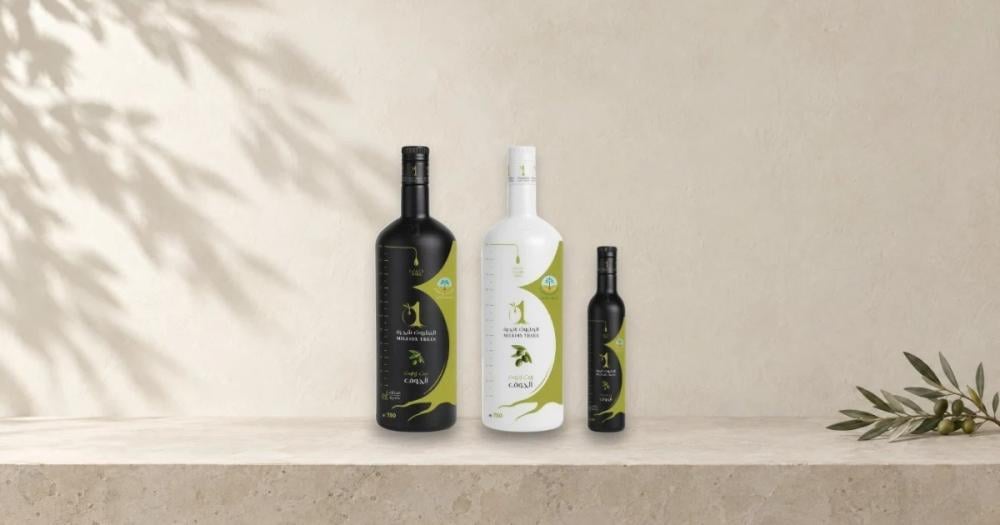
You'll find metal cans ranging from 1 to 16 liters in the Al-Jawf olive oil section , dark glass bottles from 100 to 750 ml in the glass section , and our special-pickled line in cans and dark glass. If you're looking for the fruity aroma, bitterness, and tang we described in this guide, taste your oil as described above immediately after opening it.
Frequently Asked Questions
Does the refrigerator test reveal adulterated olive oil?
No. The freezing of oil depends on its fatty acid and wax composition, as well as the temperature and duration of the refrigerator. Extra virgin oil may remain liquid, while a blended oil may freeze. Do not rely on this test in any way.
Does low acidity indicate that the oil is genuine?
Low acidity is a requirement for premium grade oil, but it is not sufficient proof, as oil refining reduces its acidity. Refined oil may have very low acidity, so other indicators such as K270, ΔK, and sterols are also tested.
Why don't I feel a stinging sensation with some original oils?
The stinging sensation is stronger in early-harvested oils and varieties rich in phenolic compounds, and lessens in late-harvested and softer varieties, and with age. Its absence alone is not indicative of adulteration, but its absence, coupled with the absence of a fruity aroma and bitterness, warrants caution.
Is green oil better than golden oil?
There is no direct correlation between color and quality. Green often comes from early fruits rich in chlorophyll, and gold from ripe fruits; both may be excellent virgin dates. Color can also be altered by dyeing, so it is excluded from professional evaluation.
How can I be sure that the analysis certificate is genuine and up-to-date?
Check the lab name, the date of analysis, and the batch or season number, and ensure the results include more than just acidity. An old certificate or one that doesn't mention the batch doesn't tell you much about the oil you have.
What should I do if I have doubts about oil I bought?
Taste it systematically and compare it to an oil you trust. If you detect a rancid or fermented smell, or a complete lack of flavor, contact the seller and request the batch analysis results. You can also report any suspected products to the Food and Drug Authority.
Genuine oil doesn't need tricks to detect. Clear information on the label, a manufacturer publishing their analyses, and a couple of minutes of tasting in a small cup in your kitchen are enough to make you a discerning buyer.